If you run a business in the UK and your website was last touched in 2023 or earlier, this article is going to be an eye-opener. The world of web design UK has shifted fast over the past 18 months, and in 2026 the gap between a good website and a great one is wider than it has ever been. More than 65% of all UK web traffic now comes from mobile devices, and Google’s ranking signals have evolved to reflect exactly that. If your site is slow, cluttered, or just not built for a small screen, you are already losing customers to competitors who got there first.
This guide walks you through what is actually changing, what the data says, and what any UK business — from a local tradesperson to a growing e-commerce brand — should be doing about it right now.
Why 2026 Is a Turning Point for UK Website Design
The digital landscape in the UK has matured significantly, and businesses that treat their website as a “set it and forget it” asset are paying the price in lost rankings and lower conversions. Google’s Helpful Content updates, Core Web Vitals requirements, and the rise of AI-powered search (including Google’s AI Overviews) have all landed in quick succession. A site that looked fine in 2022 can now actively hurt your visibility. The good news? UK businesses that invest in current web design UK standards are seeing measurable results: faster load times, lower bounce rates, and higher conversion rates across the board.
Mobile-First Is No Longer Optional
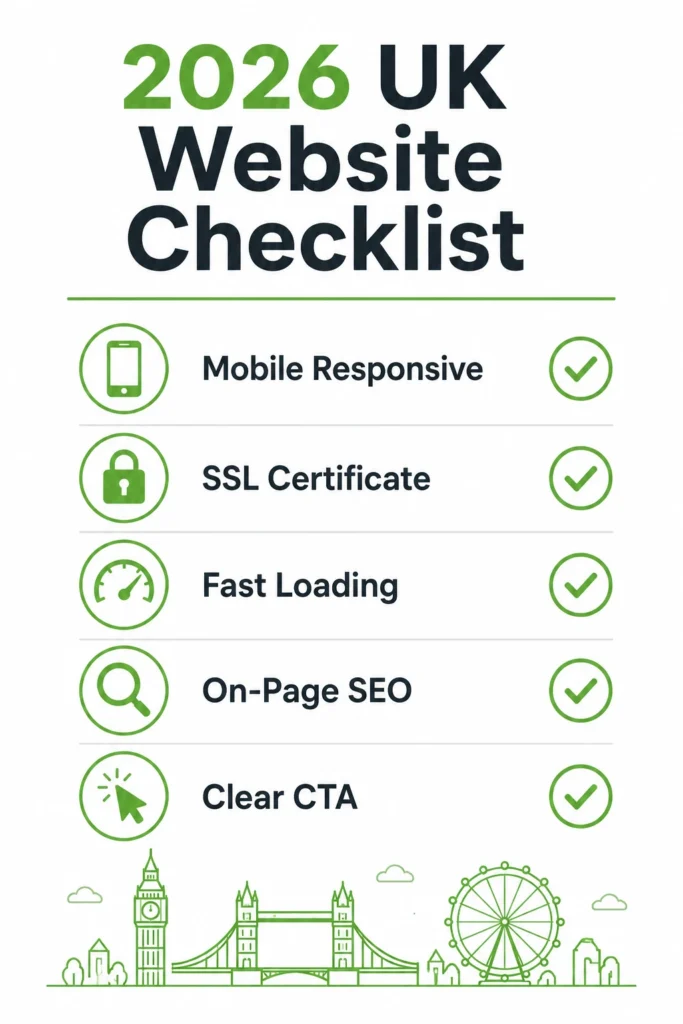
Every serious web design UK project in 2026 starts with mobile. Google indexes the mobile version of your website first, full stop. That means if your mobile experience is clunky, your desktop rankings suffer too. Responsive website design is the foundation here — your layout must adapt fluidly to any screen size, from a 6-inch phone to a 27-inch monitor.
Practically, this means larger tap targets, readable font sizes without zooming, no horizontal scroll, and fast-loading images that do not eat someone’s mobile data. The best website designers UK are now building mobile-first and then scaling up to desktop — not the other way around.
Core Web Vitals and Speed: The Numbers That Matter
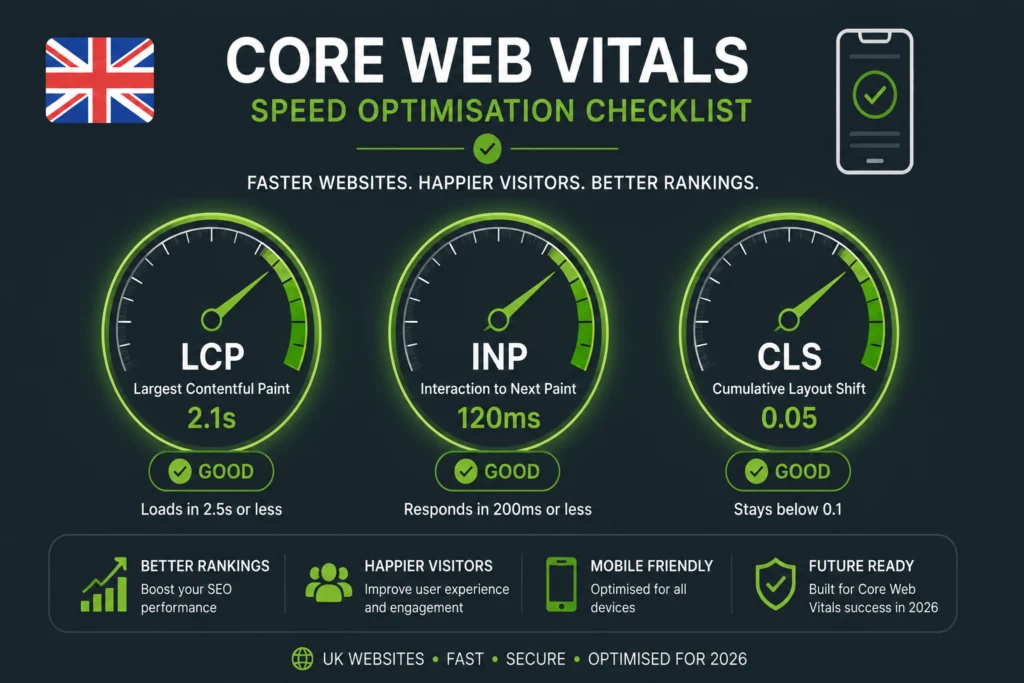
Google’s Core Web Vitals are three specific performance metrics: Largest Contentful Paint (how fast the main content loads), Interaction to Next Paint (how quickly the page responds to clicks), and Cumulative Layout Shift (how stable the layout is while loading). Sites scoring “Good” on all three consistently outrank those that do not, all else being equal. In 2026, the bar has risen again with the rollout of WebGPU-accelerated rendering in modern browsers, meaning pages built with updated web standards load noticeably faster for UK users on recent devices.
Speed optimisation is not just about SEO. Research from Google itself shows that a one-second delay in mobile page load time can reduce conversions by up to 20%. If you are using a web design service that does not include speed optimisation as a core deliverable, you are paying for something incomplete.
UX Trends Reshaping How UK Sites Are Built
UX trends in 2026 are less about aesthetics and more about intent. Visitors arrive with a specific goal, and the site’s job is to remove every friction point between their arrival and that goal being met. The biggest shifts right now: micro-interactions that confirm actions (a button that briefly animates when clicked), skeleton screens that load placeholder layouts before real content appears, and sticky navigation that keeps key links accessible without covering content.
Another major UX trend is “Generative UI” — where AI components on a page surface personalised content or recommendations based on browsing behaviour. You do not need a massive tech budget to benefit from this; even simple personalisation (like showing a returning visitor your most popular products first) can lift engagement meaningfully.
AI-Ready Design and Google’s AI Overviews
Google’s AI Overviews (formerly SGE) now appear at the top of search results for thousands of queries. To be included in those overviews, your content needs to be structured clearly — short paragraphs, specific answers, proper use of header tags, and schema markup. This is where professional web design services and strong on-page SEO start working together. A well-designed site that answers questions directly and loads fast is exactly what Google’s AI is pulling from. Sites with poor structure or slow speeds are being skipped entirely, even if their content is good.
SSL, Security, and Trust Signals UK Users Expect
An SSL certificate (the padlock in the browser bar) is a bare minimum in 2026. But beyond SSL, UK website visitors are increasingly tuned into other trust signals: visible contact information, a real address, clear privacy policies, and genuine customer reviews. The ICO’s enforcement of UK GDPR has also tightened, meaning cookie consent banners and data handling disclosures are not optional extras — they are legal requirements. Any web design service worth its fee includes all of this as standard.
Real UK Business Use Cases: What’s Working in 2026
A landscaping and gardening business in Surrey recently moved from a five-year-old static website to a modern responsive build with a mobile-optimised booking form, a gallery page showcasing completed projects, and integrated Google reviews. Within three months, their organic traffic from local search had doubled and enquiries from mobile users went up by 70%. The changes were not cosmetic — the new site loaded in under two seconds on mobile, had proper schema markup for a local business, and was structured around the specific services people in their area searched for.
A separate example: a small e-commerce startup selling artisan homeware in Manchester launched in early 2026 with a professionally built e-commerce website focused on mobile UX and page speed. They prioritised product photography loading fast on mobile, simple checkout flows, and WhatsApp integration for customer queries. Their cart abandonment rate came in well below the UK e-commerce average because the path from product page to payment was friction-free on every device.
What UK Web Design Costs in 2026: An Honest Comparison
Pricing for web design services across the UK varies enormously, and it can be hard to know what you are actually getting for your money. Below is an honest comparison of what different providers typically offer at different price points — and how our own packages at Cheap Website Designer stack up.
Price Comparison Table
| Provider Type | Typical Price | Pages | Hosting Included | SEO Included | Maintenance |
|---|---|---|---|---|---|
| Freelancer (basic) | £300 – £800 | 1 – 3 | No | No | No |
| Mid-range agency | £1,200 – £3,000 | Up to 5 | Sometimes | Basic | Extra cost |
| Large UK agency | £5,000+ | Custom | Yes | Yes | Retainer |
| Cheap Website Designer (Starter) | £69 | 1 Landing Page | 12 months free | On-page SEO | 12 months free |
| Cheap Website Designer (Small Business) | £179 | Up to 5 | 12 months free | On-page SEO (2x) | 12 months free |
| Cheap Website Designer (Elite) | £239 | Up to 20 | 12 months free | On-page SEO (4x) | 12 months free |
The value gap is significant. Most mid-range agencies charge £1,200 or more for a 5-page site without hosting or ongoing maintenance included. The Small Business package at £179 delivers up to 5 pages, 10 email addresses, free hosting for a year, 12 months of maintenance, and on-page SEO as standard.
Feature Comparison: What You Should Expect in 2026
| Feature | Basic/DIY | Mid-Range Agency | Cheap Website Designer |
|---|---|---|---|
| Fully responsive design | Sometimes | Yes | Yes (all packages) |
| Free SSL certificate | No | Sometimes | Yes (all packages) |
| Speed optimisation | No | Extra cost | Yes (all packages) |
| On-page SEO | No | Basic | Yes (all packages) |
| WhatsApp floating button | No | Extra cost | Yes (all packages) |
| Free logo design | No | Extra cost | Yes (if required) |
| 12 months free hosting | No | No | Yes (all packages) |
| 12 months maintenance | No | Extra cost | Yes (all packages) |
If you are comparing like for like, very few UK providers match this across all features at these price points. You can view the full breakdown on the pricing page.
WordPress in 2026: Still the Smart Choice for UK SMEs?
Yes, for most UK small and medium businesses, WordPress remains the most practical platform. It powers over 43% of all websites globally and has the largest ecosystem of plugins, themes, and developers. More importantly, it gives you control — you own your content, your design, and your data. An affordable WordPress website design built properly is also far easier to maintain and update over time than proprietary website builders that can lock you in or change their pricing without warning.
SEO and Web Design: Why They Cannot Be Separated
A beautifully designed site that nobody finds is not doing its job. In 2026, on-page SEO has to be baked in from the start — not bolted on afterwards. This means proper heading structure (H1, H2, H3 hierarchy), page titles and meta descriptions written with target keywords in mind, image alt text, fast load times, and internal linking between pages. If you want to go further, affordable SEO services for small businesses can add local citations, backlink building, and ongoing keyword tracking on top of the on-site foundation.
Pay Monthly Options: Making Web Design Accessible
One trend worth noting for UK businesses watching cash flow is the growth of pay monthly website design arrangements. Rather than a large upfront payment, you spread the cost over a monthly fee that often includes hosting, maintenance, and updates. This makes professional web design accessible for sole traders and startups who cannot commit to a four-figure sum upfront but still need a quality online presence.
FAQ: People Also Ask About Web Design UK
How much does web design cost in the UK in 2026?
Web design costs in the UK in 2026 vary from around £69 for a single-page professional site (with hosting, SSL, and SEO included) up to £5,000 or more for a large custom agency build. For most small businesses, packages between £150 and £400 cover everything needed for a complete, professional website. The key is making sure hosting, maintenance, and on-page SEO are included — otherwise those costs add up separately.
What is responsive website design and why does it matter?
Responsive website design means your site automatically adjusts its layout to look and work properly on any screen size — phone, tablet, or desktop. It matters because over 65% of UK web traffic is now mobile, and Google ranks the mobile version of your site first. A site that is not responsive will rank lower and frustrate the majority of visitors who arrive on a phone.
Do I need SEO included with my web design?
Yes. On-page SEO — things like proper heading structure, meta titles, alt text for images, and page speed — should be part of any web design service, not an add-on. A site that is well-designed but not SEO-optimised will struggle to rank in Google, which means fewer people find it organically. For ongoing visibility, combining your web build with an SEO service is worth considering once your site is live.
How do I find a reliable web designer in the UK?
Look for a UK-based web design service that shows a portfolio of real completed work, is transparent about what is included in each package, and includes ongoing support or maintenance. Check whether hosting, SSL, and speed optimisation are bundled or charged separately. You can review completed projects from the portfolio here to get a feel for quality and style before committing.
What is the difference between website maintenance and a website redesign?
Website maintenance covers ongoing tasks: keeping plugins updated, fixing broken links, backing up files, and making small content changes. A redesign means rebuilding or significantly overhauling the design and structure of the site. Most businesses need maintenance regularly and a redesign every 3 to 5 years as design standards and technology evolve. WordPress maintenance services can take this off your plate entirely so you are not worrying about technical upkeep.
Conclusion
2026 is a genuinely important year for UK businesses to reassess their web presence. The combination of AI-driven search, mobile-first indexing, rising user expectations, and tightening data protection rules means that a mediocre website is more costly than ever in both lost traffic and lost trust. The benchmarks have moved — and the businesses winning online right now are the ones that treated their website as a proper business asset rather than a one-time expense.
If you are ready to build something that performs in 2026, get started with Cheap Website Designer and see what a properly built UK website looks like at a price that actually makes sense for your business.